
1. Prologue
This is where the album blog begins. I want to talk about influence and process. What led to certain tracks. Who threw ideas into the room. What stuck. What didn’t. Whatever I can remember that might be even mildly interesting. Sometimes I’ll get musical and technical. Sometimes I won’t. That feels honest.
I have a lot of issues with a lot of contemporary musical theater writing. Mostly, I don’t think it takes enough risks. It’s afraid of offending, afraid of alienating, afraid of being misunderstood. So instead of throwing a curveball, it lobs a meatball straight down the middle.
(That’s the full extent of my baseball knowledge. Don’t ask me to go further.)
That said, I love musical theater. Deeply. I love the form, the history, the craft, the ridiculousness of it. I love that it asks music, language, bodies, light, and space to all agree on something at the same time. I love that it can hold sincerity and artifice in the same breath. I wouldn’t be doing any of this if I didn’t believe in it.
But I want musical theater that cuts.
I want work that isn’t polite about its feelings. I want shows that risk being misunderstood, that aren’t smoothing their edges in advance so everyone leaves feeling safely affirmed. I want music that sounds like it was written by someone who needed to get it out, not someone trying to pass a test. I want moments that feel unstable. Like they might fall apart if you look at them too closely.
When I say punk rock, I don’t just mean loud guitars or fast tempos. (Although…don’t get me wrong…turn that amp to 11) I mean intention. I mean defiance. I mean refusing to wait for permission. Punk is choosing honesty over comfort. Punk is building something out of what you have because you can’t not build it. Punk is saying, this matters to me, even if it doesn’t fit neatly into a box.
Musical theater has always had the capacity for that kind of danger. (*cough* Hair 1968 *cough*)
It just forgets sometimes. (*cough* Hair 2009 *cough*)
And when it remembers…when it lets itself be messy, uncompromising, and alive…it becomes something electric. That’s the theater I want to be part of.
What you’ll see is a lot of what I made has roots somewhere. Mostly something I’d clock in hindsight…every once in a while it’s very deliberate.
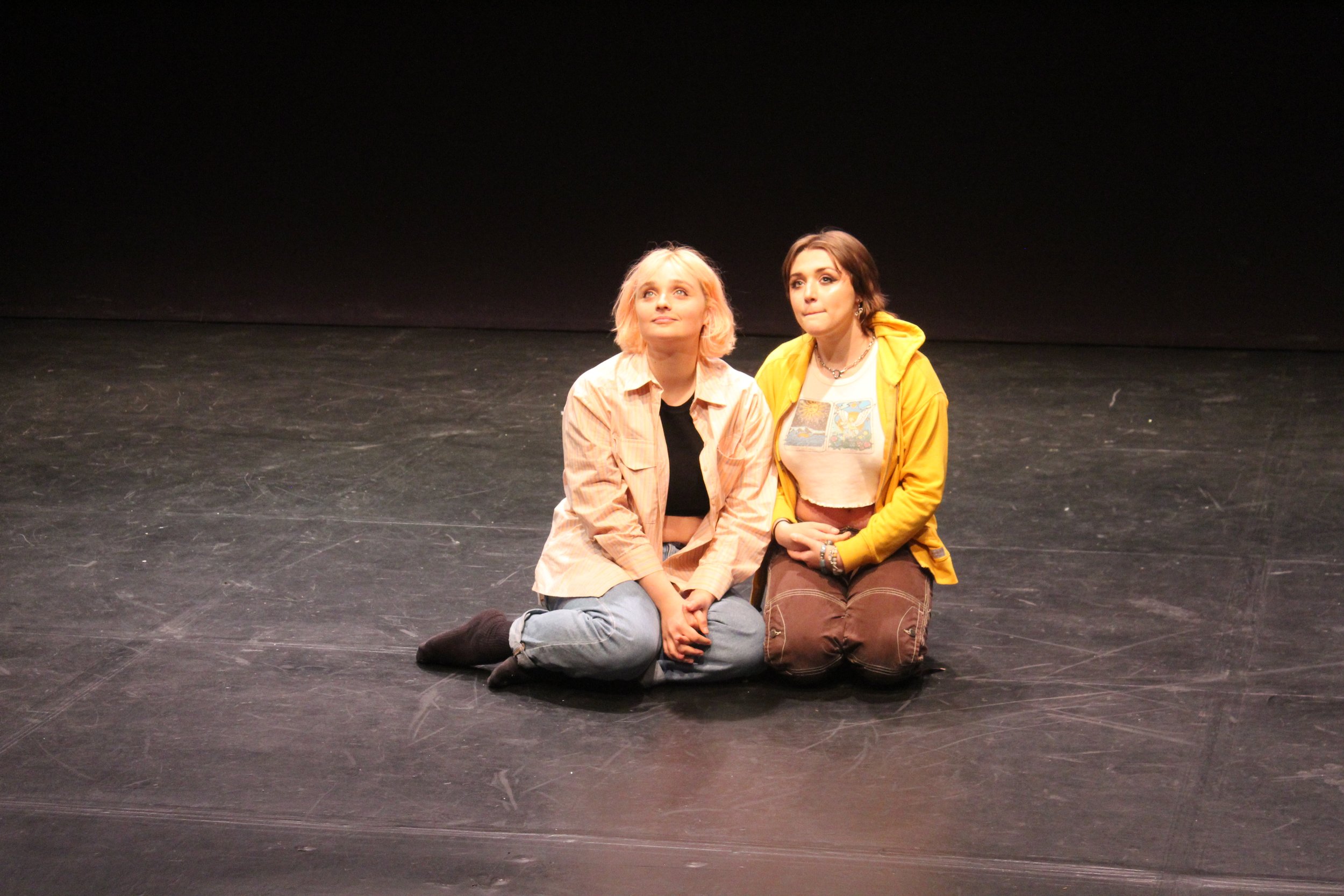
Viv Helvajian & Delilah Jane Dunn at the NYTF 2023
In our show, Vincent is female-presenting. An idea suggested early on by my friend, director, and collaborator…Alyssa Kakis. That choice was the first real crack in the foundation of the piece, and it mattered more than I realized at the time. It was the moment the show stopped trying to recreate Vincent van Gogh’s life and started trying to understand his inner weather.
Up until then, I was still orbiting the idea of a straightforward biography: dates, events, facts, the familiar arc everyone already knows but with anachronistic music. Shifting Vincent’s presentation loosened our grip on history and gave us permission to move toward something truer. The show became less about who Vincent was in a literal sense and more about what Vincent felt like.
What we’ve made now is closer to an impressionistic painting of his aura than a documentary. Memory, emotion, obsession, and fear take precedence over accuracy. Identity becomes fluid. Time bends. Characters function as forces as much as people. Vincent isn’t a museum figure…you don’t observe her from a safe distance. You experience her from the inside.
That single choice opened the door to everything that followed.
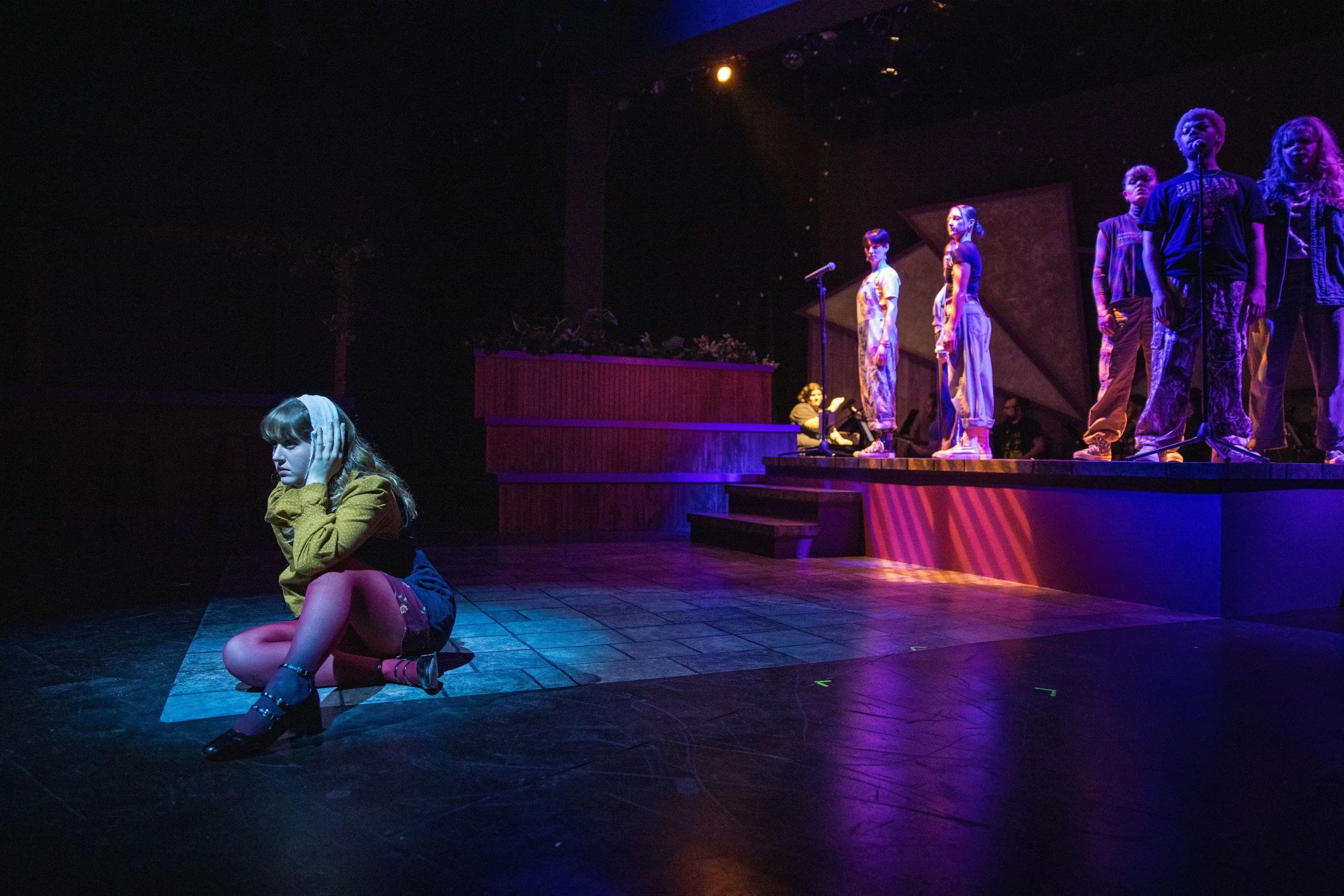
2025 LIU - L to R: Kaira Gula, Claudia McMahon, Camille Larson, Momo Greenwell, Lauren Dunn, Terrel Hall, Allie George
1. Prologue - Terrel Hall, Allie George, Claudia McMahon, Momo Greenwell, Camille Larson & Ensemble
I knew right away there wasn’t going to be an overture.
I love overtures. Truly. Old-school overtures are feats of orchestration. Little symphonies whose original job was to tell the audience to sit down and pay attention. These days, overtures either exist as nostalgia pieces or used as part of the storytelling, like Jesus Christ Superstar. Neither felt right for this show.
I wanted the first bars to feel like paint hitting canvas. One sound. Then another. Each voice a new stroke, building toward something. When the harmony finally locks and creates that audio image, it swells until we crash into the world of the show. The first clear instrument you hear is guitar. Heavy delay as we sit in this unknown and empty space
There are three things almost everyone knows about the real life Vincent van Gogh:
He cut off his ear.
He painted Starry Night.
He died by suicide.
Sometimes people collapse the ear and the suicide into one event. They’re not.
So the first instinct was to talk about the ear immediately. There’s no suspense in if it happens. Everyone knows it does. The tension lives in why.